

January hands you something rare: a garden stripped back to its bones. With the leaves gone from most deciduous trees and shrubs, you can finally see the crossing branches, the crowded centres and the tangle of last year's growth. It is also the coldest, wettest month of the year, and that matters more than most people realise. Every pruning cut is a wound, and wounds close slowly in the cold.
So the job is not to prune everything while you have the chance. It is to know which plants genuinely benefit from midwinter work, and which will sulk, bleed or lose their flowers if you touch them now.
Why January Suits Some Plants and Not Others
Two things decide the answer: sap movement and flowering time.
Plants that are fully dormant can be cut now with very little stress, and they get a whole growing season to heal around the cut. Plants that flower on wood made this year — the ones that bloom in late summer — are also safe, because you are not removing buds that would have flowered.
The ones to avoid fall into two groups. First, anything that bleeds heavily: birch, acer, walnut and laburnum all push sap from fresh cuts in late winter and early spring. Bleeding rarely kills a healthy tree, but it weakens it and looks alarming. Second, anything that flowers on last year's wood. Those spring-flowering shrubs are already carrying their buds, and a January cut takes the display with it.
Think of January pruning as structural surgery rather than a haircut. You are correcting the skeleton while the plant is asleep, not styling it while it is trying to grow.
Trees to Prune in January
Apples, pears and quinces are the classic midwinter job, including trained forms such as cordons, espaliers and stepovers. Start with the three Ds — dead, diseased and damaged wood — then work on shape.
- Take out branches that cross, rub or grow inwards towards the centre of the tree.
- On established trees, thin crowded spur clusters so light and air can reach the fruit.
- Remove no more than about a quarter of the canopy in a single winter.
- On young trees, shorten last year's leader growth by roughly a quarter to a third, cutting to an outward-facing bud.
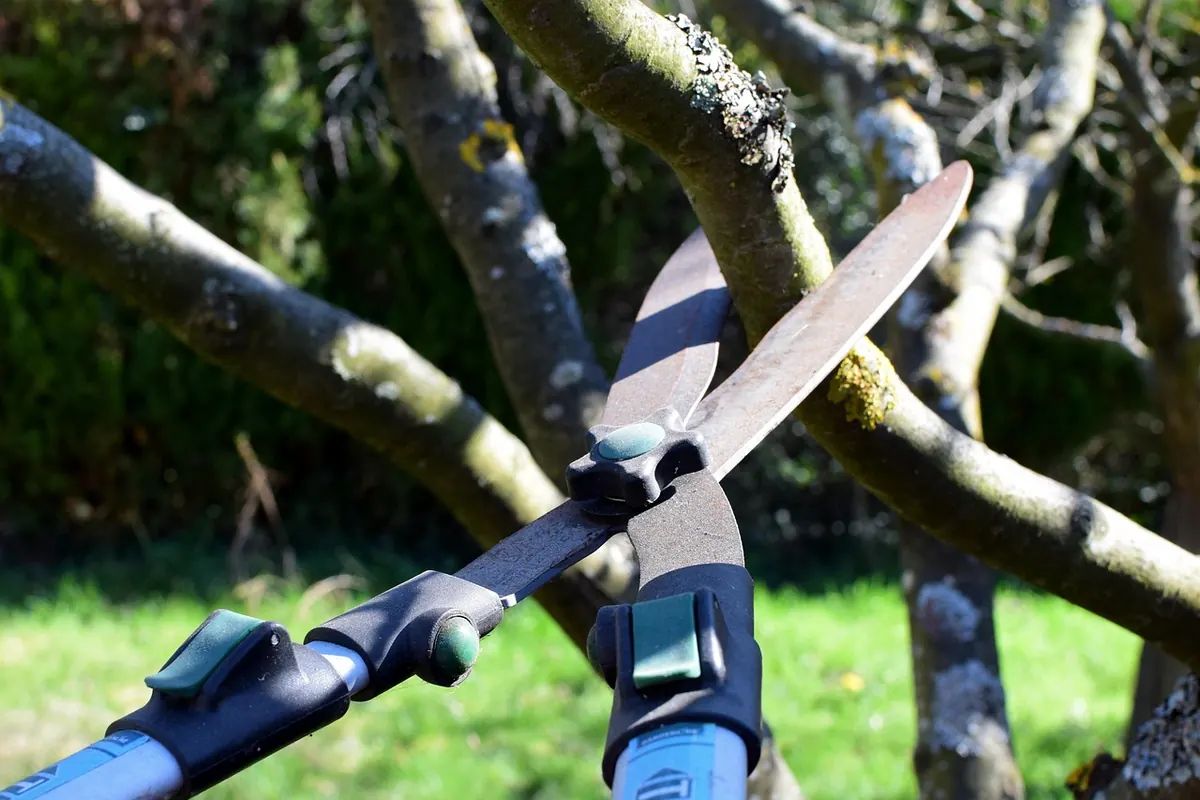
Make each cut cleanly, just above a bud or a branch collar, angled away from the bud you are keeping. Ragged, torn cuts are an open door for disease. Reach for a pruning saw once a branch is thicker than your thumb, rather than forcing loppers and bruising the bark.
Leave stone fruits alone. Plums, cherries, apricots and peaches are far better pruned in late spring or summer, when wounds close quickly. Cutting them now risks silver leaf and bacterial canker.
Old, Overgrown Apple and Pear Trees
If an apple or pear tree has not been pruned for years, resist the temptation to restore it in one dramatic session. Work over two or three winters instead. In the first January, remove the dead, diseased and rubbing branches, then thin the worst of the congestion. Leave the main framework alone until you can see how the tree responds. A hard cut on an old tree can send up a thicket of water shoots that takes years to sort out.
For example, an old 'Bramley' with a dense, shaded centre may need little more than the removal of two or three large inward-growing limbs this year. Next winter, you can shorten the remaining branches and open the centre further. Slow, incremental pruning keeps the tree balanced and keeps fruit production steady.
Shrubs, Soft Fruit and Vines That Take a Winter Cut
Soft fruit
Blackcurrants are best pruned between late autumn and early spring. Cut out around a third of the oldest stems at ground level each year and you keep the bush young and productive. Redcurrants and gooseberries also respond well to winter work: shorten the new growth on the main framework and cut out low, crowded stems.
Autumn-fruiting raspberries can be cut to the ground now, or any time before new growth starts. Summer-fruiting raspberries are different: leave the new canes and only remove the old, fruited canes after harvest. If you mix the two up in January, you will cut away this summer's crop.
Wisteria and vines
Wisteria is the star of the January pruning calendar. If you shortened the long, whippy side shoots to about five or six buds in summer, go back now and cut those same shoots to two or three buds. This is what pushes the plant into flowering rather than leafy growth, and it keeps the framework tight against a wall.
Grape vines, indoors or out, should be pruned in midwinter while they are fully dormant and before the sap begins to rise. Cut the side shoots back to one or two buds from the main rod.
Shrubs grown for coloured winter stems — dogwoods and willows — should be left alone for now. Cutting them in January removes the very stems you are enjoying in the border. Do that job in late February or March, just as new growth starts.
Climbers and Evergreens
Most evergreen shrubs and climbers are better pruned in spring, once the worst of the cold has passed. Cutting them now leaves open wounds through the frostiest weeks, and regrowth will be slow and half-hearted.
There are exceptions. Ivy and other evergreens that have outgrown their space can be trimmed lightly during a mild spell, but never in a hard frost — frozen stems shatter instead of cutting cleanly. And if you are tidying hellebores, don't call it pruning: simply remove the old, spotted leaves at ground level so the flowers show properly and disease has less to work with.
Extra Jobs That Pair Well With January Pruning
While the pruners are out, a few small habits make the whole job more useful.
- Clean your tools as you go. Wipe blades with methylated spirits or a garden disinfectant between plants, especially after cutting anything diseased.
- Sort the prunings. Healthy woody stems can be chopped and used as a mulch or added to a dead hedge. Diseased material should go in the council green waste, not the compost heap.
- Mulch after pruning. A layer of well-rotted compost or bark around trees and shrubs conserves moisture and feeds the soil, but keep it clear of trunks and stems.
- Check ties and supports. Winter is the best time to see whether a tree tie is rubbing or a climber wire has come loose.
What to Leave Alone in January
A surprising amount. Anything that flowers before midsummer is usually best pruned straight after flowering, when you can see exactly what you are doing.
- Forsythia, lilac, mock orange, deutzia, weigela and flowering currant
- Early-flowering clematis and winter jasmine — wait until they have finished flowering, then tidy them immediately.
- Buddleja davidii, if you garden in a cold area — leave the hard cut until March or April.
- Japanese maples, birches, walnuts and laburnums — avoid fresh cuts because they bleed.
- Hydrangeas that flower on old wood — leave the old flower heads for frost protection and prune in spring.
A Simple January Pruning Checklist
- Check the weather. Choose a dry, mild spell, not a hard frost. Frozen wood is brittle and cuts badly.
- Identify the plant first. If you are not sure what it is, do not cut. A five-minute search now saves a year of regret.
- Start with the three Ds. Dead, diseased and damaged wood always goes first, whatever the plant.
- Step back often. Prune from the outside in, and look at the shape from several angles before making a big cut.
- Disinfect between plants. A clean cut is only an advantage if the blade is clean too.
January pruning is less about tidying and more about setting up the year ahead. Do the right jobs now — apples, pears, blackcurrants, wisteria and dormant vines — and leave the bleeding trees and spring-flowering shrubs in peace. The garden will look bare for a few more weeks, but the structure you build this month will pay you back in fruit, flowers and light for the rest of the season.
Photo: schraubgut / Pixabay